
Martinsburg City Directory Holdings
Martinsburg city directories survive in several runs rather than one complete annual sequence. R.L. Polk titles form the early spine, while the West Virginia Archives supplies a long but uneven later list. The Campbell Beall Room holds old local volumes without publishing every shelf year. Treat each catalog as evidence of what that keeper reports, not proof that every intervening edition exists.
| Collection | Years | Where Held | Access |
|---|---|---|---|
| R.L. Polk Martinsburg volumes | 1913–14, 1915–16, 1918–20, 1922, 1925, 1927, 1929, 1932, 1934–35 | FamilySearch films 2310198 and 2310199; DGS 9181344 and 9181345 | Catalog; images may require login or affiliate access |
| Gale directory reels | 1913/14–1925, 1927–34/35, 1937/38–47, 1949–60, with named gaps | City Directories of the United States reel set | Institutional or microfilm access |
| West Virginia Archives volumes | 1915–16, 1922, selected 1957–2016 editions | West Virginia Archives, Charleston | Catalog and in-person use |
| Campbell Beall local books | Old Martinsburg directories; exact shelf run not published | Martinsburg-Berkeley County Public Libraries | Appointment, self-directed research |
| Sanborn map companions | 1885, 1891, 1897, 1902, 1907, 1913, 1922, 1931 | WVU and Library of Congress collections | Digitized building, block, and use context |
The Gale finding aid identifies missing editions within its spans, including 1917, 1921, 1923, 1924, 1928, 1930, 1931, 1933, 1941, 1943, 1944, and 1946. Do not silently fill those gaps. The Archives list later includes 1957, 1963, 1967–78, 1980–87, 1989–92, 1995–2002, 2004–07, 2009–10, and 2012–16.
Polk’s Martinsburg Directory Years
The FamilySearch Martinsburg city directory catalog identifies the publisher and item-level years for the early run. Film 2310198, DGS 9181344, contains 1913–14, 1915–16, 1918–19, 1920, 1922, and 1925. Film 2310199, DGS 9181345, contains 1927, 1929, 1932, and 1934–35. Those numbers are useful when asking a FamilySearch Center or affiliate library for help.
The catalog page describes microfilm of originals held at various libraries and societies. A camera icon may mean that images are available, but access can still depend on login, copyright, privacy, or a custodian agreement. The catalog is therefore a precise finding aid, not a promise that every page will open from home.
William & Mary also describes a digitized West Virginia city and business directory database covering 1839 through 1929. Access may depend on an affiliated library. If the image is unavailable, carry the exact title, year, film, item, and DGS number to the next access point.
Martinsburg Directories at the Library
The Campbell Beall Room sits on the top floor of the Martinsburg library at 101 W. King Street. Access is by appointment during the published windows of Wednesday from 3 to 5 p.m. or Saturday from 10 a.m. to noon. Call 304-267-8933 through Information Services before traveling. Library staff offer limited source guidance but do not conduct full genealogical research for patrons.
The room holds old Martinsburg city directories, local family and correspondence files, obituary indexes, cemetery records, tax and census sources, and deeds and land material. Its geographic reach includes Berkeley, Jefferson, Morgan, and Hampshire counties plus nearby parts of Maryland and Virginia. That broader scope helps when a household leaves Martinsburg but remains in the Shenandoah Valley region.
The local-history page captured in the manifest is the source for the room’s services and holdings.
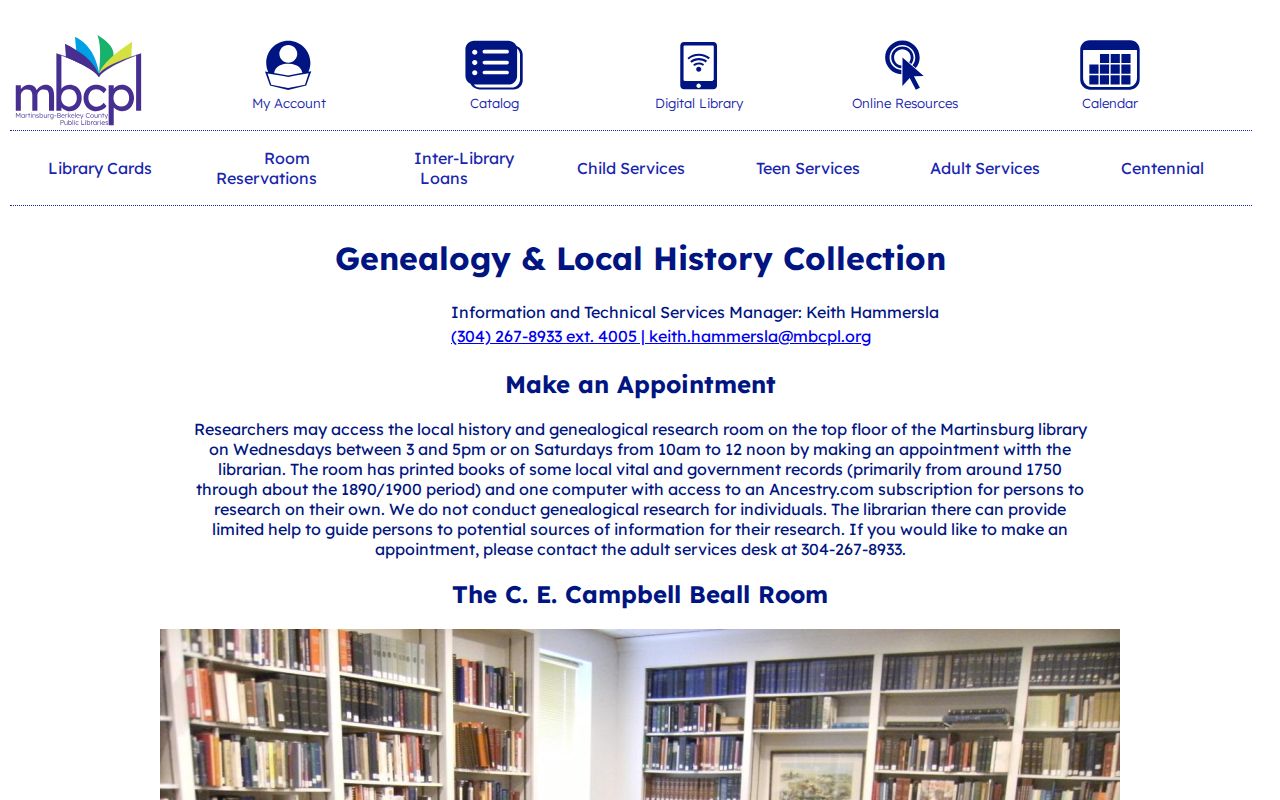
The capture leads into the practical fallback: arrive with names, spelling variants, likely years, addresses, and catalog numbers so a short appointment can focus on the right shelf or reel.
Read a Martinsburg Directory Entry
A city directory entry is a dated publisher’s snapshot. Start with the front matter because symbols and short forms can change by edition. Transcribe the original line before expanding any term. The alphabetical section usually centers on people or firms, while later volumes may add a street-order section, classified business pages, advertisements, and civic organizations.
| Name line | Surname, given name, or initials; a spouse may appear in parentheses or a relationship notation. |
|---|---|
| Work line | Occupation, trade, employer, or business may be named. |
| Place line | House number and street; a residence line should be kept distinct from a business address. |
| Status mark | Householder, owner, renter, boarder, or roomer symbols vary and must be checked against that edition. |
| Family clue | Widow or spouse notation can connect a household between editions. |
- Criss-cross directory
- A street-order section that lists entries by address instead of surname.
- Householder index
- An address-oriented list of the person the publisher treated as the principal household entry.
- Abbreviation key
- The edition’s own explanation of its short forms and symbols, often placed near the front.
A listing does not prove legal title or every person in the home. Publication work may have happened months before the cover date, and absence can mean a move, nonresponse, exclusion, or coverage boundary.
Extend Martinsburg Directories with Newspapers
The library’s newspaper microfilm covers Berkeley, Jefferson, and Morgan County papers from 1791 to the present. Search the surname, spouse, street, business, and legal-notice terms within a narrow date range. An obituary, sale notice, marriage item, or civic report can explain why a name appears, moves, or vanishes between city directory years.
Microfilm prints cost 20 cents, and images may be saved to a user-supplied USB drive. Record the title, issue date, page, and image location. Optical character recognition can miss old type, so read the surrounding page rather than relying on a search hit alone. The State Archives county guide separately identifies the Martinsburg Gazette from 1810 through 1855.
Sanborn fire-insurance maps add building footprint, use, street, and landmark context for eight Martinsburg editions from 1885 through 1931. They are not an occupant list. Pair a directory’s exact street number with the nearest Sanborn sheet, then test that location against a deed plat or modern GIS parcel.
Historic Berkeley’s Martinsburg Collections
Historic Berkeley operates an Archives and Research Center at 136 E. Race Street by appointment. Its holdings include family and architectural records, maps, photographs, manuscripts, microfiche, local publications, and cemetery material. On-site research is listed at $30 per hour. Staff research also costs $30 per hour with a two-hour minimum.
The successful manifest image below links to the organization’s information page.
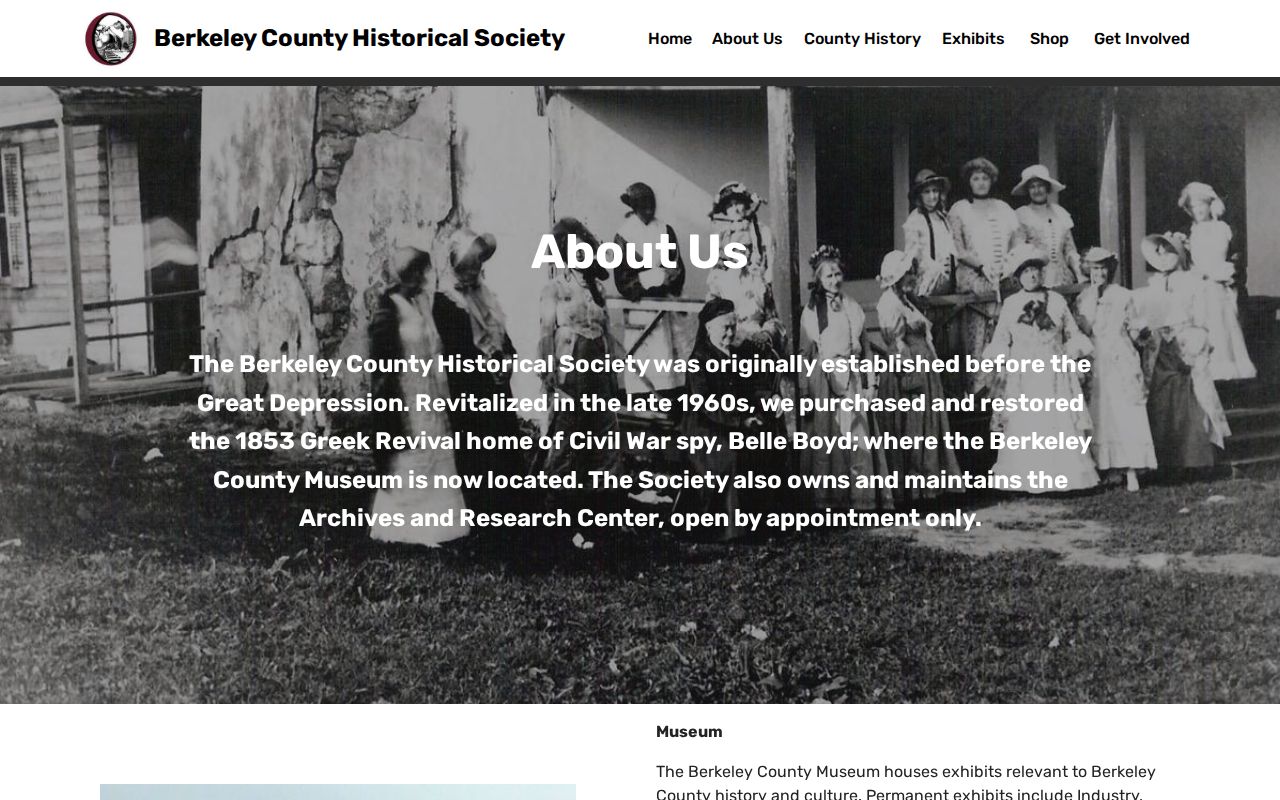
Use a city directory find to make the request narrow: give the exact name, edition year, street line, likely family file, and the question that remains. Historic Berkeley can add architectural or family context, but a secondary note should be checked against the directory image, deed, census, or civil record.
Martinsburg Records Across Time
Local history explains why city directory evidence must be layered. Martinsburg was founded in 1778, decades before commercial directories. The B&O reached the city in 1842, and its roundhouse and shops shaped work listings, Irish Hill geography, and newspaper coverage. The railroad strike of 1877 may surface people in civic and labor reports that do not appear in a directory line.
| Date | Record-history marker |
|---|---|
| 1772 | Berkeley County formed; early court, deed, will, and marriage series begin in county custody. |
| 1778 | Martinsburg founded. |
| 1842 | B&O arrival adds railroad, shop, and worker context to local records. |
| 1913–14 | First Martinsburg Polk edition identified in the researched catalog run. |
| 1922 | Courthouse fire causes significant damage and makes substitute sources important. |
| 2012–16 | Latest Martinsburg editions listed in the inspected State Archives holdings. |
The 1922 fire is a practical myth check. A blank modern index does not establish that a record never existed. Note whether the replacement is an original, later copy, microfilm image, index, abstract, newspaper report, or historical account.
Trace Families in Martinsburg Directories
City directories bridge the long spaces between public census schedules. They can place a name at an address and show work or spouse context, while a released census can describe the household, ages, relationships, and enumeration geography. Federal schedules through 1950 are public under the 72-year rule. Later schedules are not yet open.
- Find the earliest likely edition and copy the exact name, spelling, address, work line, and spouse notation.
- Check the next available volume, not merely the next calendar year. Mark every catalog gap.
- Use the street-order section, when present, to test nearby households and address continuity.
- Pair the directory nearest a released census year with the correct ward or enumeration district.
- When the name disappears, search surname variants, an employer, obituary index, cemetery book, probate file, and nearby jurisdictions.
Disappearance can mean death, a move, a new surname, nonresponse, or being outside the publisher’s boundary. Do not choose one explanation without another dated source. Berkeley deed and probate microfilm, obituary files, and vital indexes can test the possibilities. For a current parcel check after the historical trail, use the Martinsburg street directory.
Note: Preserve the directory’s original spelling even when a modern street, family name, or business record uses a different form.